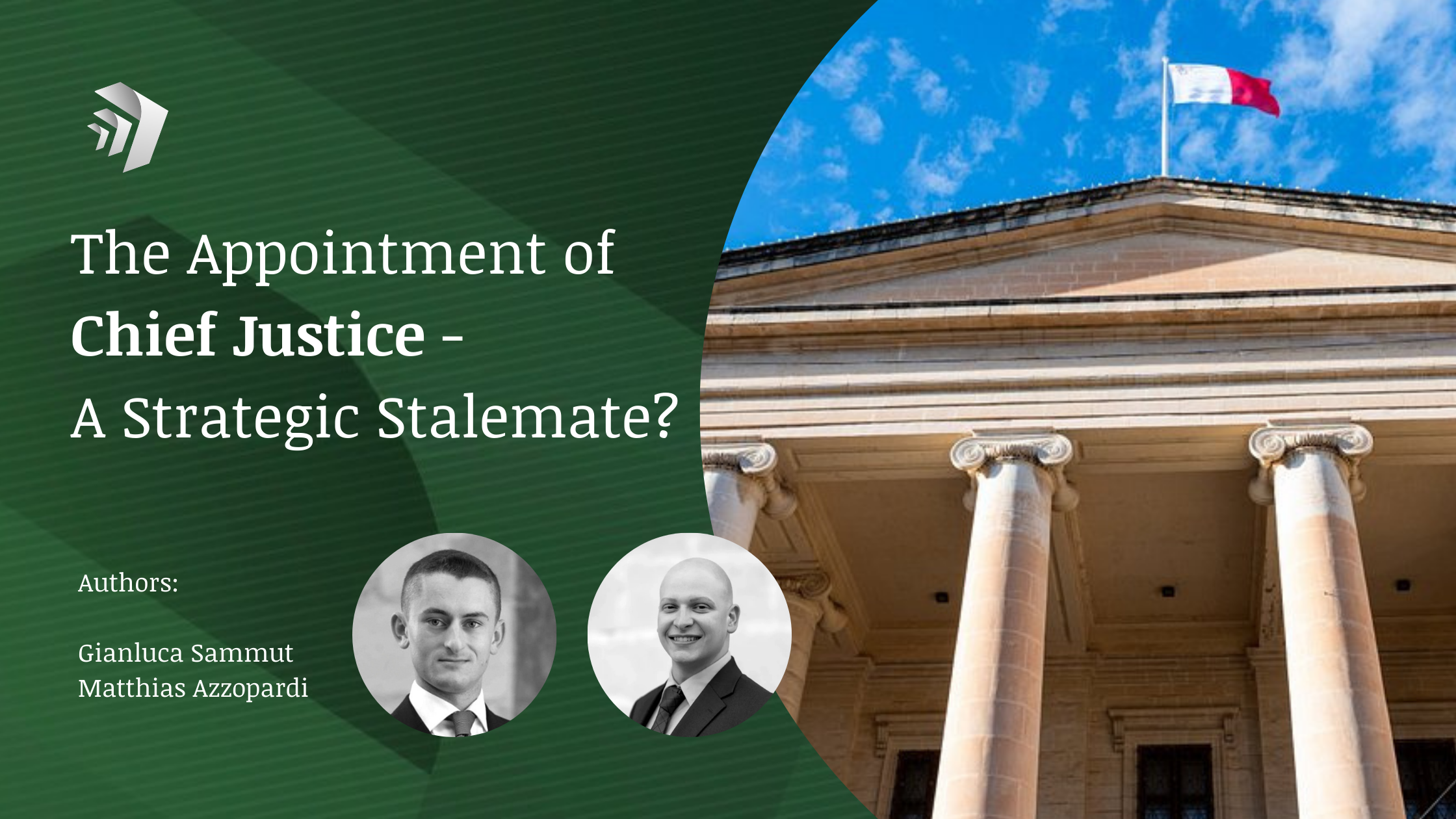
Although a stalemate in chess ends in a draw, it may be used by a player with an inferior position with one simple goal – to not lose the game.
The same sense of stalemate is evident in the ongoing impasse over the appointment of a new Chief Justice. As this appointment remains deadlocked, the incumbent Honourable Chief Justice Mark Chetcuti continues to hold office until a successor is agreed upon, despite passing the age of retirement.
This raises questions: What happens if the current Chief Justice is no longer able to serve? Is this role being used as a pawn in a much larger partisan game of chess? What are the legal ramifications?
First, we must understand the historical context regarding the appointment of the office of the Chief Justice, which has undergone a significant constitutional transformation since Malta’s Independence.
Since 1964, the appointment of Malta’s Chief Justice followed the same procedure as that of other members of the judiciary, whereby the President appointed judges acting on the advice of the Prime Minister. This meant that the Prime Minister exercised near-unfettered discretion in appointing the Chief Justice.
This scenario, as you can imagine, was unfavourable and opened the door for strategic appointment. Consequently, constitutional reforms introduced in 2020 fundamentally changed this balance of power, by requiring the President to act on the advice of a two-thirds majority of the House of Representatives.
On the face of it, having our elected representatives in Parliament agree on a common name to serve such a crucial role screams democracy! However, today’s predicament shows that the reformed system risks reaching its breaking point and showing what lies beyond its surface.
This breaking point bears the name of a stalemate.
Accordingly, the Constitution, in an attempt to balance the potential ramifications of the two-third majority rule, incorporates what many at the time cited as an “anti-deadlock safeguard” whereby, in the absence of the required parliamentary supermajority, the incumbent Chief Justice remains in office until a resolution is secured. The objective was to ensure the continuity of judicial leadership by preventing a vacancy in the office, supposedly standing in the way of constitutional chaos. However, this does not constitute an anti-deadlock safeguard, as it provides no mechanism for resolving a deadlock and merely allows the possibility for it to persist indefinitely.
This constitutional framework is now being tested to its limits and uncertainties still remain in the event that the House remains at a deadlock, leaving the subsequent course of action unclear, creating potential procedural and legal complications in the process.
This poses a threat to the overall judicial and democratic system in Malta, and depending on what happens next, this current stalemate may go down in history, marking the 2020 constitutional amendments as a catalyst for a constitutional calamity.
The answer to our question potentially lies in article 98 of the Constitution, which states that if the office of Chief Justice is vacant or if the Chief Justice is for any reason unable to perform the functions of his office, then, until a person has been appointed, those functions shall be performed by an acting Chief Justice who shall be a judge of the Superior Courts as nominated by the President, acting in accordance with the advice of the Prime Minister.
If this wording rings a bell, you are right to assume that this position is near-identical to the pre-2020 reform, potentially unveiling the true strategic form of the constitutional stalemate.
The gambit, for those who wish to rely on it, is to accept the deadlock long enough until the Chief Justice is unable to perform the functions of his office – at which point the mask is unveiled and the Prime Minister may advise the President on who is to be nominated as the acting Chief Justice.
This reflects the inherently political and partisan character of constitutional law, which at times can resemble a game of chess. The Constitution functions merely as the board on which the game unfolds. What is clear is that the 2020 reform, and its often incorrectly labelled “anti-deadlock safeguard” is not what it purports to be. Rather than resolving institutional impasse, it appears to create opportunities for the strategic manipulation of that very deadlock.